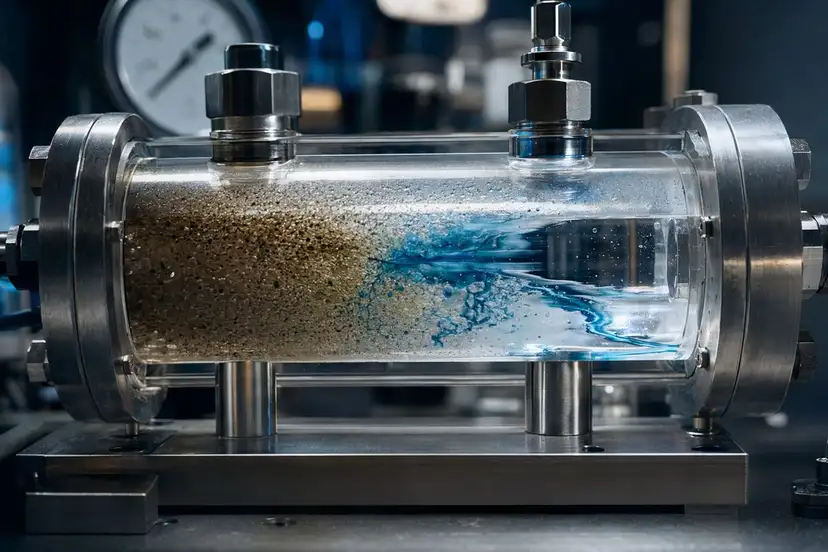
Why residue cleanup became a product-manager problem in fracturing fluids
Residue cleanup used to be treated as a field execution issue: choose a breaker, load the job, monitor viscosity reduction, and move on. That view is too narrow for today’s fracturing-fluid product teams.
For oilfield chemical service companies, cleanup performance now affects product positioning, field trial design, customer claims, supply planning, and the commercial risk attached to every fluid package. Product managers are expected to support performance language that is credible across basins, while operations teams still need practical chemistry that works under variable downhole conditions.
That is why the role of an enzyme breaker supplier for oilfield fluids has changed. The question is no longer simply, “Can this breaker reduce gel viscosity?” It is, “Can this breaker fit the formulation, timing window, temperature profile, water chemistry, logistics model, and customer claim we are putting into the market?”
Cleanup is no longer just a lab endpoint
In a controlled bench test, polymer degradation can look straightforward. In the field, residue cleanup is influenced by interacting variables:
- Polymer type and loading
- Crosslinker chemistry and delayed-crosslink behavior
- pH trajectory before, during, and after placement
- Bottomhole temperature and heat-up profile
- Brine hardness, TDS, and produced-water contribution
- Oxidizer or encapsulated breaker co-use
- Biocide, surfactant, scale inhibitor, friction reducer, and clay-control packages
- Pump schedule, residence time, and leakoff behavior
For a product manager, this means one cleanup claim can become several different operating windows. A breaker that performs well in one formulation may need adjustment in another. A product that is cost-effective in a moderate-temperature system may be poorly matched to a high-pH or high-salinity program.
The practical challenge is to turn variable field chemistry into a product line that sales, technical service, procurement, and operations can all defend.
The commercial tension: stronger claims versus safer claims
Customers want cleaner fractures, faster flowback, and lower residue risk. Suppliers want differentiated products. But overclaiming cleanup creates long-term problems.
A useful product claim needs to be specific enough to matter and conservative enough to survive real operating conditions. Product managers often have to ask:
- Is this cleanup benefit tied to a defined fluid family, or is it being presented too broadly?
- Does the breaker timing match the intended fracture geometry and pump schedule?
- Does the enzyme remain practical under the expected pH and salinity range?
- Is performance repeatable with actual field water, not only clean lab water?
- Can technical service explain the limitation without weakening the value proposition?
The goal is not to promise universal cleanup. The goal is to define where the chemistry is useful, where it needs a co-breaker or formulation adjustment, and where it should not be positioned.
Breaker timing is a product feature, not a footnote
Delayed cleanup is valuable only when it is delayed for the right reason. If viscosity drops too early, proppant transport and placement can be compromised. If breakdown occurs too late, the operator may see slower cleanup, higher retained polymer risk, or a less convincing production story.
Enzymatic breakers are often considered because they can offer controlled polymer degradation under selected operating conditions. For product teams, the key issue is not a generic “fast” or “slow” profile. It is whether the timing fits the commercial fluid system:
- Linear gel or crosslinked gel
- Moderate-temperature or higher-temperature application
- Freshwater, brackish water, or produced-water blend
- Short residence time versus extended exposure
- Standalone breaker use versus hybrid breaker strategy
A good product brief should describe the intended timing window in field language. Product managers need to connect chemistry behavior to job design, not just to a simple before-and-after viscosity result.
Compatibility drives adoption
Oilfield fluid packages are rarely built around one component. A cleanup additive has to live inside a crowded formulation.
Compatibility questions usually determine whether a breaker can move from technical interest to commercial use:
With polymers
Different guar derivatives and cellulose-based systems may respond differently to enzymatic degradation. Product managers need to understand which polymer families are the best fit and where response may be slower or less predictable.
With crosslinkers
Crosslinked systems introduce timing complexity. The breaker must support cleanup without undermining the transport function of the gel. Product documentation should be clear about where the enzyme is intended to sit in the breaker strategy.
With pH buffers
Enzyme behavior is strongly tied to pH. That does not mean enzymes are fragile by default, but it does mean pH control belongs in the product conversation from the beginning.
With water chemistry
Field water is not a laboratory solvent. Hardness, iron, dissolved solids, and produced-water variability can all affect formulation performance. Product teams should validate with representative waters before writing broad claims.
With other additives
Biocides, surfactants, scale inhibitors, corrosion inhibitors, clay stabilizers, friction reducers, and oxidizing breakers may all be present. The question is not whether a breaker works in isolation; it is whether it remains useful in the actual package being sold.
Cost cannot be evaluated per drum alone
Breaker cost is often viewed as a unit-cost issue. Product managers usually need a wider lens.
A lower-cost breaker can become expensive if it requires excessive loading, creates inconsistent cleanup, complicates field handling, or forces the service company to narrow its claims. A higher-value breaker may be justified if it improves formulation reliability, reduces reformulation work, or supports a premium fluid package with clearer technical boundaries.
Commercial evaluation should include:
- Effective use range across target formulations
- Storage and transport practicality
- Batch-to-batch reliability
- Technical support burden
- Need for complementary breaker chemistry
- Ease of explaining the value to field and sales teams
- Availability during seasonal or regional demand shifts
For a product manager, the real metric is fit-for-purpose economics, not the lowest line item.
Field validation has to be designed for variability
A single clean trial is useful, but it rarely answers the product-manager question. The better question is whether the breaker performs consistently enough across the intended application envelope.
A stronger validation plan may include:
- Representative source waters from target basins
- Multiple polymer and crosslinker combinations
- Temperature profiles that reflect expected well conditions
- pH conditions aligned with the actual formulation
- Side-by-side comparison with existing breaker strategy
- Residue or cleanup observations that match the claim being made
- Field feedback from flowback, production, and post-job technical review
The goal is not to generate a perfect data set. The goal is to identify where the product is robust, where it is sensitive, and where the commercial language needs limits.
Supply reliability is part of performance
A breaker that works technically but cannot be supplied reliably is not a product platform. Oilfield chemical service companies need dependable sourcing, documentation, and communication around lead times.
Product managers should consider:
- Manufacturing consistency
- Forecast support for regional demand
- Packaging formats suitable for blending and field logistics
- Technical documentation for internal qualification
- Change-control communication
- Continuity planning for high-demand periods
In oilfield chemicals, supply reliability is often invisible until it fails. Product teams that treat supply as part of the product specification reduce the chance of emergency substitutions and unplanned reformulation.
The new role of the enzyme breaker supplier
A useful supplier does more than ship chemistry. For product managers, the right technical partner helps define application fit.
That includes support for:
- Matching breaker chemistry to polymer family and operating window
- Screening compatibility with common fracturing-fluid systems
- Interpreting pH, temperature, and salinity constraints
- Building credible trial plans
- Framing cleanup claims without overextending them
- Supporting scale-up from lab evaluation to field qualification
- Maintaining consistent supply for commercial programs
For FracTide Labs, the value conversation starts with formulation fit and field realism. Enzymatic breakers are not positioned as universal answers. They are tools that can be selected, validated, and supplied for defined fracturing-fluid programs.
What product managers should ask before adding a cleanup claim
Before residue cleanup becomes a line in a product brochure, ask these questions:
- What exact polymer system is the claim tied to?
- What downhole temperature range is realistic for this positioning?
- What pH range does the chemistry need to see?
- Does produced water change the expected response?
- Is the breaker timing aligned with pump schedule and proppant transport?
- What other additives are likely to be present?
- Is the claim supported by representative field-water testing?
- Can the field team explain when not to use the product?
- Is the supply chain strong enough to support adoption?
If those answers are not clear, the issue is not only technical. It is a product-management risk.
Practical takeaway
Residue cleanup has become a product-manager problem because it sits at the intersection of chemistry, claims, cost, compatibility, and field variability. The best breaker choice is rarely the most dramatic laboratory result. It is the option that fits the fluid system, supports controlled timing, can be validated under representative conditions, and can be supplied consistently.
FracTide Labs works with oilfield chemical service companies evaluating enzyme breaker options for defined fracturing-fluid programs. If your team is building or revising a cleanup package, we can review formulation requirements, operating windows, and supply expectations before you commit to a commercial claim.
Request a quote for enzyme breaker supply and formulation-fit discussion.